Handrails, Ramps and the Small Repairs That Keep an Older Home Safe
Most safety problems in an older home are small, fixable jobs, and a repair assistance program exists for families who need a hand.
October 16, 2026 · 4 min read
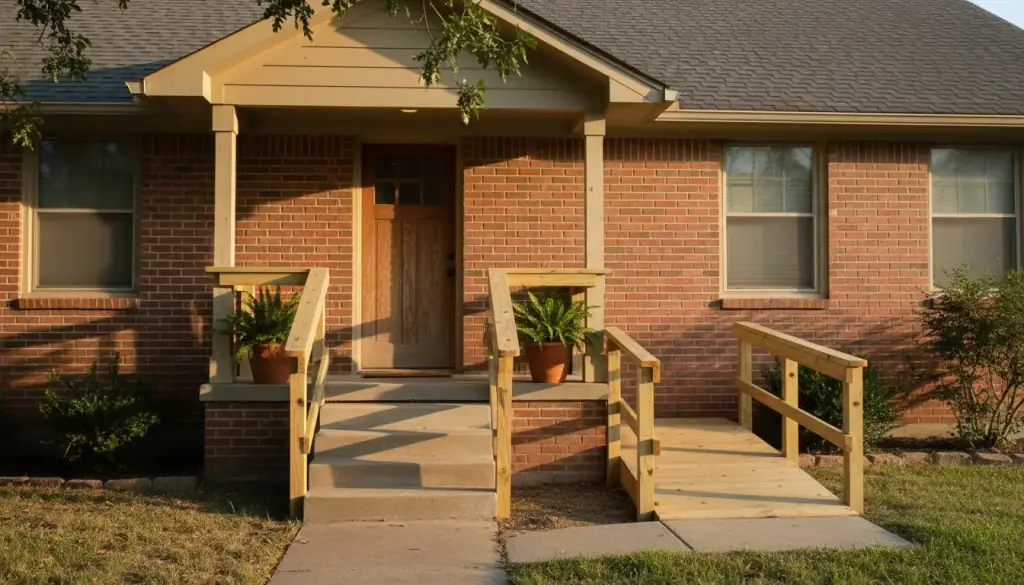
When a parent or grandparent has lived in the same house for decades, the house becomes invisible. The front steps have always been a little uneven. The bathroom floor has always been slick when it is wet. Nobody notices, until somebody stumbles.
If you are the adult child helping an older relative stay in their own home, or you are an older homeowner yourself, this post is for you. The good news is that many of the repairs that matter most are small, practical jobs, and help exists for families who cannot afford them.
Start with the places people fall
Walk the house the way your relative does, from the car or the street to the bed, and look at each place where a foot could catch or a hand could miss something to hold.
- Entry steps: look for loose, cracked or uneven treads, and any step that is taller than the rest.
- Handrails: a rail should be solid when you lean on it, on every set of stairs, inside and out.
- Thresholds: a raised door threshold is a classic tripping spot.
- Walkways: cracked or lifted concrete and loose pavers are easy to miss and easy to trip on.
- Bathroom: slippery floors, a shaky towel bar used as a handhold, and a tub that is hard to step into.
- Lighting: dim hallways, stairs and entries make every other hazard worse.
Write down what you find, then put the list in order. Anything where a fall is likely and the fall would be serious goes first.
Why handrails and ramps matter
A sturdy handrail is one of the least expensive safety upgrades in a house, and one of the most effective. It gives a person something firm to grab at the moment their balance wavers. A loose rail can be worse than no rail, because people trust it and then it gives way.
A ramp solves a different problem. For someone who uses a walker or a wheelchair, or who simply can no longer manage steps safely, a ramp is what makes the front door usable again. A good ramp has a gentle slope, a solid surface that grips when wet, and rails where they are needed. Because the slope matters so much, it is a job for a professional to plan, not a weekend guess.
The quiet repairs that add up
Not every safety repair is dramatic. Some of the best ones are basic maintenance that was put off.
- Tightening or replacing loose hardware on rails and doors.
- Fixing a drip under the sink before it rots the cabinet floor.
- Securing a wobbly step or board before it breaks.
- Replacing burned-out or too-dim bulbs in hallways and stairwells.
- Testing the smoke alarms and replacing batteries on a schedule you can remember.
These jobs are small, but they stack. A house where the small things are handled is a house where the big things are less likely to sneak up on you. An inspection can help here, since an inspector looks at the whole house and can tell you which items deserve attention first.
How a repair assistance program works
Many families know exactly what needs fixing and simply cannot pay for it. That is the situation a nonprofit repair assistance program is built for.
The program helps elderly and low-income families with essential home repairs, so the home stays safe, comfortable and livable. The work centers on minor repairs, safety upgrades such as handrails or ramps, and basic maintenance for homes that need extra care. Most of the services are free. Depending on the scope of a project, a minimal admin or project management fee may apply, and that is worth asking about up front.
The program is funded by home inspection income. In plain terms, when a buyer or homeowner books an inspection, part of that business supports repairs for a family that needs them. It is a simple loop, and it means the program does not depend on handing a bill to the person who needs the help.
Getting started
If you are not sure whether a particular repair fits, the easiest move is to ask. Describe the problem in a sentence or two: where it is, what is wrong, and who lives in the home. You will find out what can be done without having to prepare paperwork first.
Before you call, it helps to have the address, a short list of the repairs you are worried about, and a note about any mobility needs. Photos are useful if you can take them.
One Stop Shop runs the repair assistance program out of Cedar Hill, Texas, for elderly and low-income families. To ask about a handrail, a ramp or another small repair, call or text (469) 658-2483, Monday to Friday, 9 to 5.
One Stop Shop All Solutions LLC, (469) 658-2483
Call (469) 658-2483More articles
How a HUD FHA 203K Consultant Can Help You Renovate Your Home?
A worn-out house can be a smart buy when the repair plan is solid, and the consultant is the person who builds that plan with you.
Protect Your Investment: The Power of a Home Inspection
A home inspection is a two-to-four hour look at the whole house, and the report it produces can change what you pay or whether you buy.